 Happy new year! Agoucha, Toon, Neko [pronounce N- e (like the first e of there) ko (like in in loCO)] and I wish everyone a healthy and happy new year!
 The tower farm keeps growing slowly and surely! Some plants seems that they are really liking it there, especially the collard greens. I Also am pretty sure that I need to add more light to the system. Also the compost tea "experiment" is continuing, and so far it does not seem to provide significant amount of nitrates. Here is a breakdown of the state of things from top to bottom.
 On the top, the is a pepper seedling, It grew in the compost from the worm crate and I transferred the 2 leaf seedling into the vertical farm a little while ago. It now has 4 leaves, and seems quite happy there.
 Next there is one of the collard greens that grew its longer leave from 7.5 cm to 10 cm now. It also has added new leaves. (see second photo)
Next there is the parley, I harvested half of the leaves last week (not much, but it was tasty). this week it put out 2 leaves (stimulated by the cut ?)(see second photo)
Next there was a small 3 leave seedling of parsley that died, not sure why, but it became suddenly totally dry.
 Then the is the bok choy core that seems to grow too, and added a few new leaves in the last 3 weeks.
 Another collard grows lower, it also have grew new leave regularly, but it is not as green as the one on the top of the tower. This is what makes me think I need more lights. The light are placed on the top.
 Notice on the picture how the collard on the left is not as intensly green as the one on the right.
 Also There were a few green onions lower, but they died (except one that is higher in the tower) after I did the monthly cleanup. I have disturbed them, and they didnt like it, maybe added to insufficient light also participated, as they were not as green as the one closer to the top.
When I did the clean up there was a bit of a biofilm in the reservoir, internet sources are no agreeing whether it s good or bad, but logically, since we are dealing with a system full of life, I would expect such biofilm to develop.
 For the water quality, I have hiked up the amount of ammonia to 4 ml for about a week, and there is now an obvious accumulation of ammonia and nitrate, with some traces of nitrite. I have back down the additions of ammonia as I would aim for an amount that gets quickly processed into nitrates. I am also wondering if this increase of ammonia may be in part linked to the cleanup - which may a killed some of the living film, releasing ammonia as it decomposes.
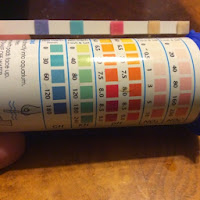 For the compost tea addition, I have kept increasing the amount of compost used. Yesterday, I have added 2.5 cups of compost to 4 cups of water, and "brewed" for 24h with aeration. I finally got around to get test strips to look at nitrates, and it does not show a significant amount of nitrate in the compost tea. However, the stips also measures general hardness (180 ppm) carbonate hardness (120ppm) pH (7.5) and nitrites (0 or maybe traces).
Finally, I seems that the Blog will pass the bar of 1000 views ! that is quite exiting, Last check I had 997 views!


 20 kg (45 pounds) of diverse food scraps, including supposed no-noes like onion peel, lemon, garlic ... in moderation, there is no problem really, and anything else vegetable based, and used coffee grounds


