 |
| The farm from above |
 |
| The farm from bellow |
 |
| pH has decreased then increased since no new ammonia was added |
The reason is that I decided to have an apprenticeship about aquaponics with Citizen Schools and while discussing with the Citizen Schools people, the fish seemed to be a down side for my plan, so I ruthlessly removed the fish from the picture.
Citizen schools is an association that brings professionals to teach after hours classes (apprenticeships and other programs) to selected middle schools in NYC. Only schools that have 85% of student who are eligible for free or reduced lunch due to their parents low income. Since the fall semester I have been volunteering there for an apprenticeship where we teach our students about heart health. Anyway, A few weeks back I proposed to have an apprenticeship where we would build an aquaponic system with the students and learn about the basic science behind it. So after discussion with the school staff I settled for an "other"ponic system, instead.
Since my all point about starting the system was not only to grow some food at home, but also on a sustainable manner, hydroponic seems like a bad alternative to aquaponics. From the sustainability point of view, hydroponic seems a bit difficult given the need to do full water change, and the need for concentrated fertilizers. An Internet search for compost tea tends to make one inclined to believe that compost tea is the panacea for organic gardening, because of beneficial microbes and a balanced NPK. This is why I have been experimenting with compost tea.
 |
| The farm has cycled, and nitrate dropped to 0 |
I have been making compost tea in the last 3 week ends, increasing the amount of worm compost each week. After "brewing" the tea, I measure the amounts of nitrate and ammonia. So far, I was not able to have a nitrate (or ammonia) level above the detection limit. last week end, I have "brewed" a compost tea using 1/4 of a cup of worm compost, 1 table spoon of molasseses (unsulfured) and shredded seaweeds in 2 cups of water, brewed it for a day and half. After a days and half, it still smelled like molasseses (I like that smell). I also added some of this greengrow plant food, very diluted. Because I have just seen the nitrates dropping, I decided to add some ammonia source, I though about eggshells, but the pH has increased to 7.4; so given the pka of 9 for calcium carbonate (witch is what eggshells are made of) I am not sure it is a good idea. Instead I bough a 1/2 gallon bottle of ammonia at the dollars store and added one mL (a bit less than 1/4 of a teaspoon) of it on Monday and Tuesday ( gave ~ 1 ppm reading) nothing yesterday, and now ammonia is back to 0. I will keep adding 1ml everyday for now, until I figure out how to make a strong enough compost tea (if that is possible).
I am keeping track of my experiment hoping that I could make a sustainable "tea"ponic system for the school.


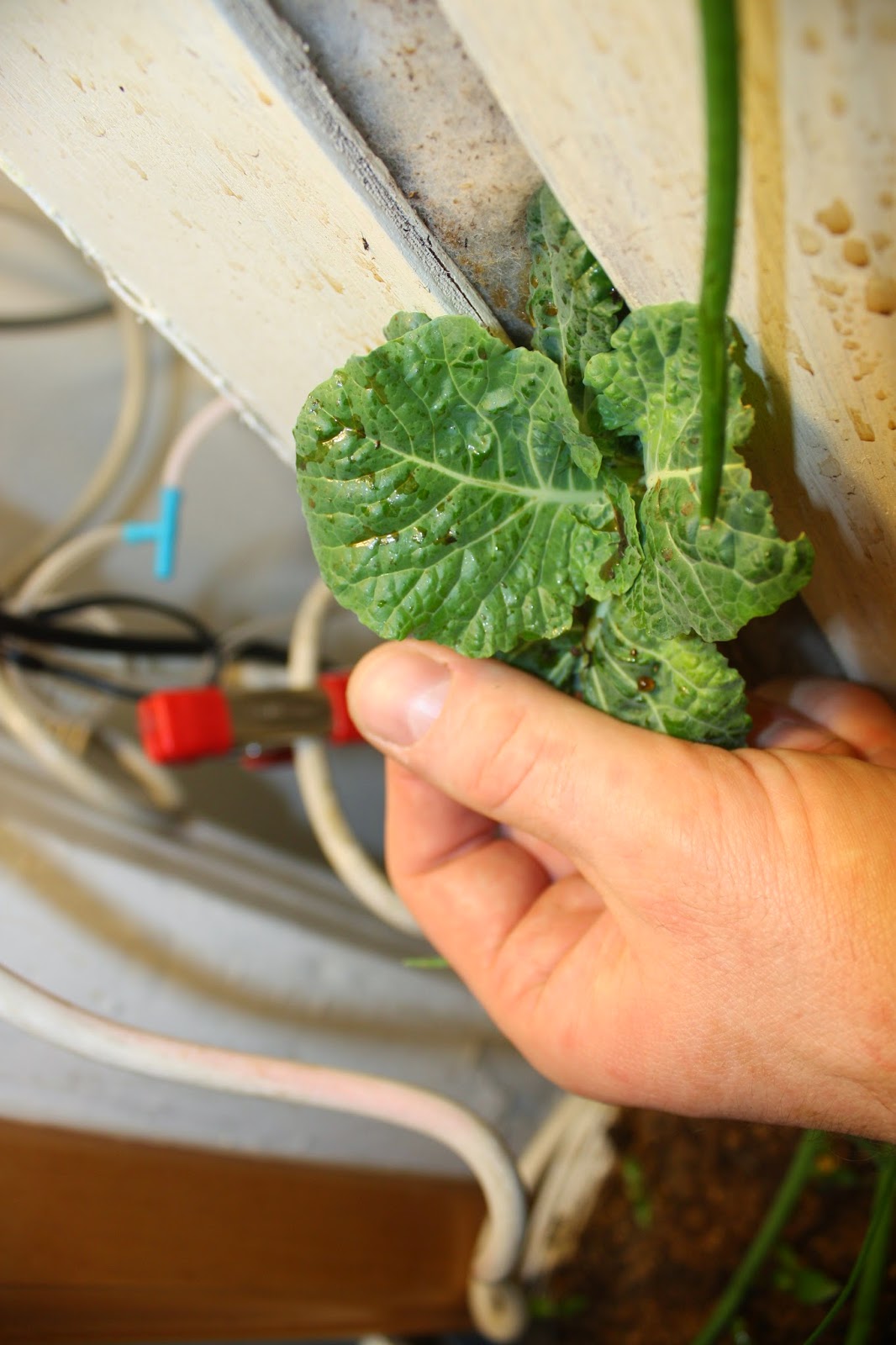 The bigger collard greens, with plenty of leaves growing from it.


 It now has been almost 2 months that I built the vertical farm ! and things are going along pretty well ! I have some parsley growing, a few green onions, 2 collard green plants and swiss chard. The parsley that got burned by the light bulb that was too close almost made it, but I pulled it out to make space for the seedlings to come. A few weeks back Ive planted the core of 2 collard greens and one of a swiss chard, just to see, and last weekend when doing a bit of cleaning I pulled a bit on one of the collard greens and was happy to see a few tiny roots that where growing out of it ! The collards, swiss chard and onions are all "salvage" from the kitchen scraps.
  I have kept adding 2 mL of NH4OH to make sure that there is enough nitrogen. I have kept increasing the amount of compost I use to make the compost tea, so far I am at 1 cup - which is 240 mL - of worm compost for 2 cups (480 mL) of water. Depending on the volume in the tank I am either using "new" water, or water form the system, and "brew" it for about a day and a half. After that i measure if there is ammonia and nitrate in there. Given the coloration from the compost (of course filtered) its really difficult to tell, but so far, it does not seem that there is large amount of it. Possibly, the different compounds of the compost interfere with the kits reactions. I may get these strips to see if the results are different form the API kit I have. The systems water has some ammonia (the one i add) but no nitrite or nitrate accumulating. The Ph seem stable around 7 ish : the ammonium hydroxyl I add probably buffers the acidification due to nitrification, as well as the compost tea.


